ColibriOS template demo. Use this template
KestrelFloorworksCall Wes(555) 014-0388

Home / Selecting your floor

Flooring guide by Wes Hadley

Selecting your floor

Five kinds of floor, what each one costs, how many years to expect and where each lets you down. Written by the person who lays them.

A flooring showroom can hold two hundred samples that look alike from six feet away. This page is here to narrow that down before you spend a Saturday there.

Price follows quality more often than not, but the dearest board is not always the right one. A floor has to suit the room it goes in: the moisture, the traffic, the dog, the subfloor underneath.

One thing I say on nearly every estimate: my hours are about the same whether I lay a bargain plank or a very good one. The tear-out, the prep and the cuts do not get cheaper with the material. So the cheap floor that needs replacing in eight years is paid for twice, and the good one is paid for once.

The price ranges and lifespans below are what I have seen on my own jobs around the lake. Treat them as a starting point, since the product, the room and how hard a household lives on a floor all move the numbers.

Read the warranty before you buy. A maker willing to stand behind a floor for decades, and to cover it in a shop or office as well as a home, is telling you something about how it is built.

The photos on this page are from Kestrel Floorworks jobs.

Flooring compared at a glance

MaterialMaterial priceLongevityBest known for
Solid hardwood$6 to $12 per square foot for material60 to 100 years with careIt is wood all the way through, and nothing else looks or sounds the same underfoot.
Strand woven bamboo or eucalyptus$4 to $7 per square foot for material30 to 50 years with careHard enough to shrug off dropped pans and dog claws.
Engineered hardwood$4 to $9 per square foot for material20 to 40 yearsThe surface you walk on is real wood.
Vinyl plank$2.50 to $5 per square foot for material15 to 25 yearsWater cannot hurt it, so it suits kitchens, baths, mudrooms and basements.
Laminate$1.50 to $4 per square foot for material10 to 20 yearsThe lowest price of the five.

Prices are for material only and lifespans assume ordinary household use. Your product and your rooms will shift both.

Solid hardwood

The floor every other floor is trying to look like.

Boards milled from a single piece of wood, nailed down one row at a time. Plenty of houses in town still have the fir or oak they were built with.

Price range
$6 to $12 per square foot for material. Oak, maple and fir sit at the low end, and imported or figured species climb from there.
Longevity
60 to 100 years with care.

Hardwood flooring installation in Sandpoint

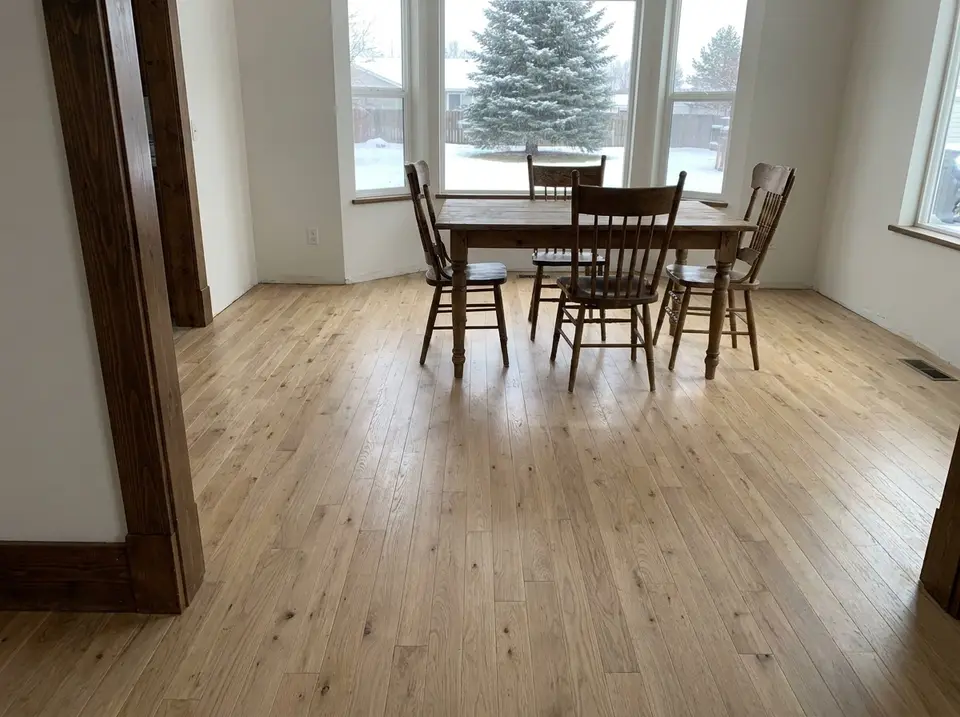
New white oak floor in a dining room with a bay window

Pros

  • It is wood all the way through, and nothing else looks or sounds the same underfoot.
  • A worn floor can be sanded back and finished again, several times over its life.
  • Nailing it down is slow but simple work, with few surprises.
  • Tongue and groove boards can be laid in borders, herringbone or a mitred frame around a hearth or a tile inset.

Cons

  • It costs the most up front, and some species take weeks to arrive.
  • Softer woods such as fir and pine mark and dent under chairs and claws.
  • Standing water is its enemy, so it needs thought near sinks, tubs and back doors.
  • Factory finished boards have small bevels and seasonal gaps that some people notice. A wax stick hides the worst of them.
  • Timber from poorly managed forests carries a real cost. Ask where the wood was cut.
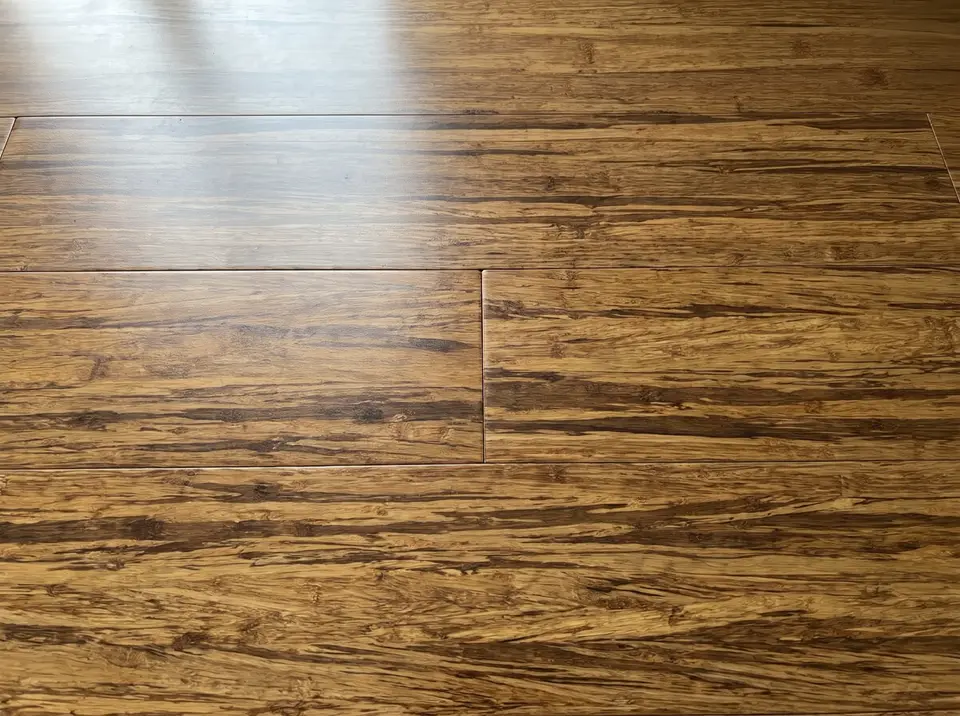
Strand woven bamboo or eucalyptus

Very hard, quick to regrow, and the one I put in my own kitchen.

Fibers of bamboo or eucalyptus are pressed under heat into dense planks that outscore oak and maple on hardness tests. The grain has a look of its own, and for the years of service you get, the price is fair.

Price range
$4 to $7 per square foot for material.
Longevity
30 to 50 years with care.

Bamboo and eucalyptus flooring in Sandpoint

Close view of the grain in a strand woven bamboo plank floor

Pros

  • Hard enough to shrug off dropped pans and dog claws.
  • Bamboo and eucalyptus regrow in a few years, not a few decades.
  • A natural material, so no two planks match exactly.
  • Usually in stock, where some hardwoods are a long wait.
  • Goes down much like hardwood: steady work, no special tricks.
  • Light scratches disappear under a tinted wax stick.
  • Handles spills and wet boots well once it is down.

Cons

  • It is too dense and too thinly finished to sand like oak. A badly damaged plank is cut out and swapped.
  • A dull surface can be buffed and given a fresh factory-type topcoat, which costs less than a full refinish but is not a job for a weekend.
  • As with any factory finished plank, small gaps may show between boards in a dry winter. Wax helps with some and the rest are part of the floor.

Engineered hardwood

A thin layer of real wood on top of a layered core.

Engineered boards give you a real wood face where solid boards are a poor fit, such as over a concrete slab or radiant heat. In price and behaviour they sit between solid wood and laminate.

The versions I like best pair a tough wood or bamboo face with a rigid waterproof core.

Price range
$4 to $9 per square foot for material.
Longevity
20 to 40 years.

Vinyl plank, laminate and engineered flooring in Sandpoint

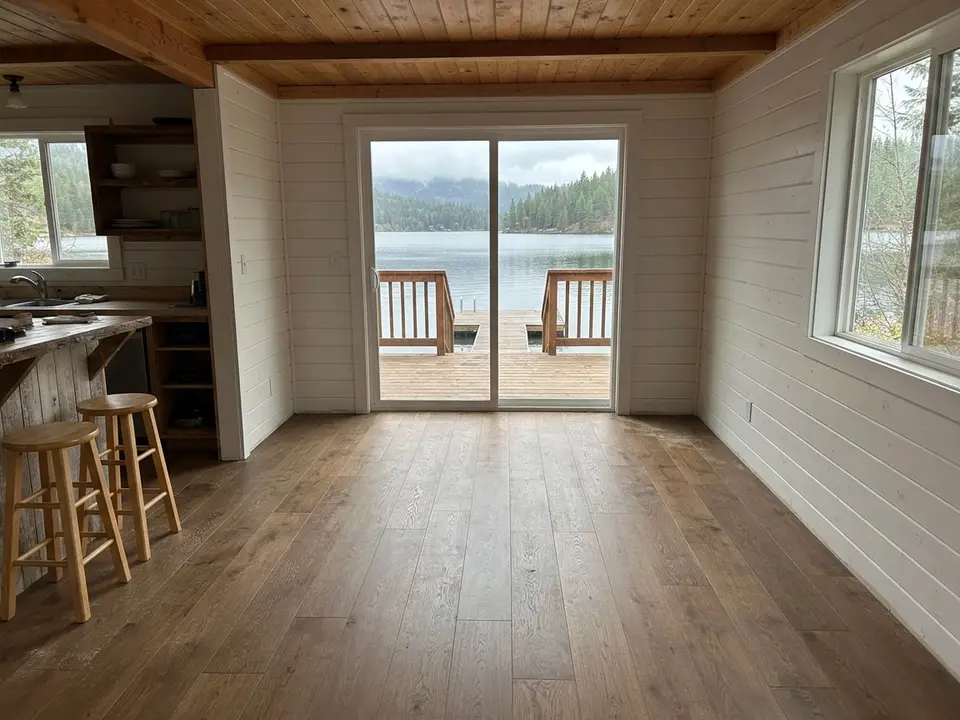
Engineered oak floor in a lake cabin, looking out to the dock

Pros

  • The surface you walk on is real wood.
  • The layered core moves less with the seasons than a solid board.
  • Costs less than most solid hardwood.
  • Click-together types float over the subfloor and go down fast.
  • Many can also be glued or nailed for a firmer feel, at the cost of more hours.

Cons

  • The wood face is thin. It dents more easily than vinyl or laminate, and when it wears through there is no second chance.
  • The hard factory finish does not take kindly to sanding, so most engineered floors are never refinished.
  • It is still wood. Water resistant versions buy you time with a spill, not a flood.

Vinyl plank

Waterproof, forgiving and hard to hurt.

Between vinyl plank and laminate I reach for vinyl in most houses. Water does nothing to it, and it bends enough to sit well on a floor that is not perfectly flat. It costs a little more than laminate, and several of the large flooring makers sell a good one.

Buy the thick plank with the thick wear layer. The weak point on any click floor is the joint, and a thicker plank has more joint to hold on with.

Price range
$2.50 to $5 per square foot for material.
Longevity
15 to 25 years.

Vinyl plank, laminate and engineered flooring in Sandpoint

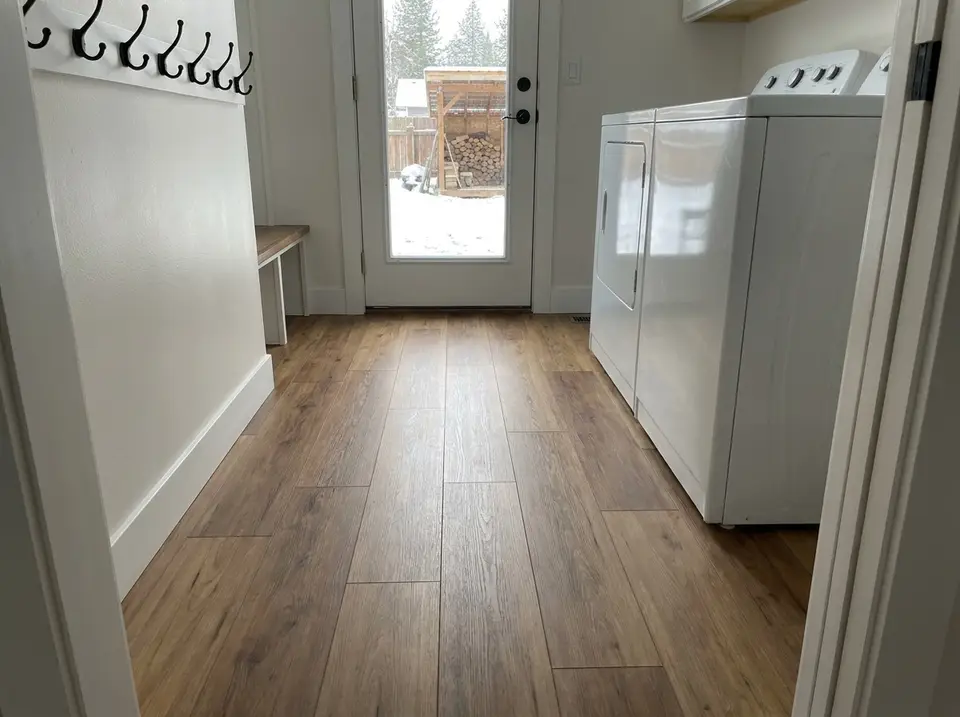
Vinyl plank floor in a back entry beside a washer and dryer

Pros

  • Water cannot hurt it, so it suits kitchens, baths, mudrooms and basements.
  • The wear layer resists scratches from grit, chairs and pets.
  • Barely moves with heat and humidity.
  • Moderate price.
  • Most planks come with a pad already attached. I still like a separate underlayment on a hard or noisy subfloor.
  • It can be laid the day it arrives, with no wait for it to settle to the house.

Cons

  • The click joints are the fragile part, and a careless tap can snap one. That is the main reason installation matters with this floor.
  • Thin planks let you feel every ridge in the subfloor. Thicker planks and better pads cost more and are worth it.
  • The printed surface can chip at an edge if something heavy lands on it.
  • It imitates wood, and from some angles the cheaper ones look like what they are.
  • Deeply textured planks hold on to dirt, and some seem to gather pet hair with a little static cling.

Laminate

A printed wood pattern under a hard clear coat, on a pressed wood core.

Quality varies a great deal from one laminate to the next. Look for a board at least 10 mm thick with a water resistant rating, and skip the bargain bin. Laminate does its best work in dry, flat rooms that do not see heavy traffic, when the budget is the first concern.

Price range
$1.50 to $4 per square foot for material.
Longevity
10 to 20 years. A thick, well made board laid on a flat subfloor can do better.

Vinyl plank, laminate and engineered flooring in Sandpoint

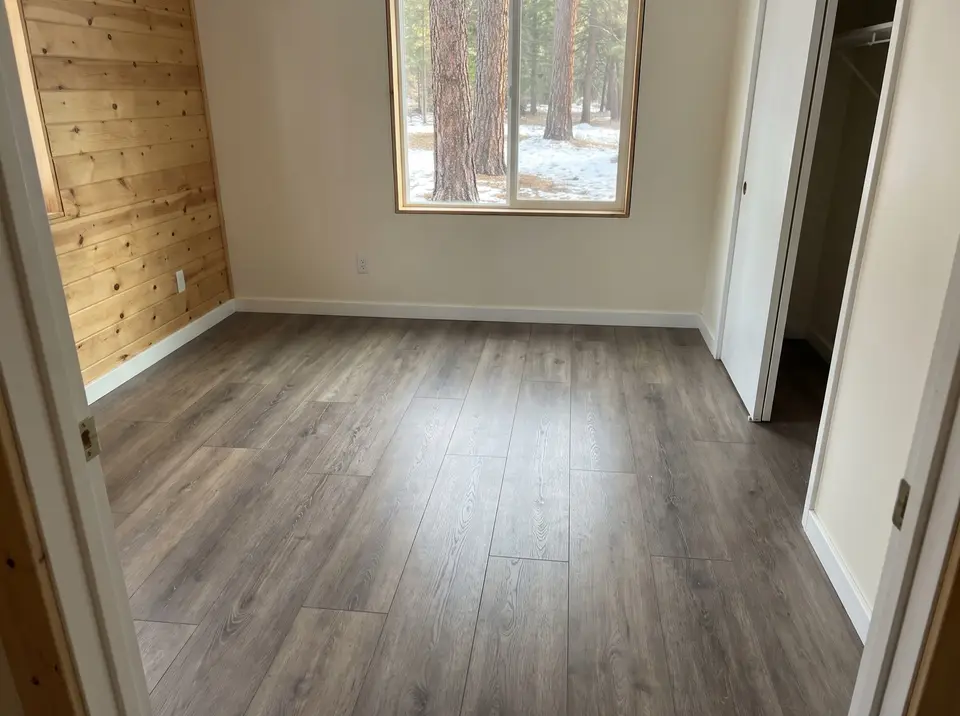
Grey-brown laminate floor in a cabin bedroom

Pros

  • The lowest price of the five.
  • Smooth and quick to sweep and mop.
  • The top coat resists scratches well.
  • Fast to lay.
  • Feels soft underfoot with a good pad beneath it.

Cons

  • Water is the problem. Once it reaches the core through a joint, the edges swell and do not go back, so most laminate is a poor choice for baths and laundry rooms.
  • The hard, thin surface chips when something sharp or heavy hits it.
  • Busy hallways and entries wear it out early.
  • The cheapest boards are brittle and their joints fail under ordinary use.
  • The pad is usually separate, which adds a step and some cost, though a thick one improves the feel and the sound.

Short answers

Flooring questions, answered

Which flooring lasts the longest?

Solid hardwood, at 60 to 100 years with care. Strand woven bamboo or eucalyptus follows at 30 to 50 years, engineered hardwood at 20 to 40, vinyl plank at 15 to 25 and laminate at 10 to 20.

What is the cheapest flooring to install?

Laminate, at about $1.50 to $4 per square foot for material. It also wears out soonest and should stay out of wet rooms, and the labor is much the same as for a better floor.

What flooring is waterproof?

Vinyl plank and ceramic tile are waterproof. Strand woven bamboo and eucalyptus cope well with spills. Laminate and engineered hardwood can both be damaged by water that sits.

Which wood floors can be refinished?

Solid hardwood, several times over. Most engineered hardwood should not be sanded, and strand woven bamboo or eucalyptus is buffed and re-coated instead.

How do I judge the quality of a flooring product?

Start with the warranty: a long one that also covers commercial use is a good sign. For vinyl plank, pick a thick plank with a thick wear layer. For laminate, 10 mm or more with a water resistant rating.

Start your project

Tell Wes about your floor.

Call, text or email for a ballpark figure. A written bid comes after a visit to measure, free within 20 miles of Sandpoint.